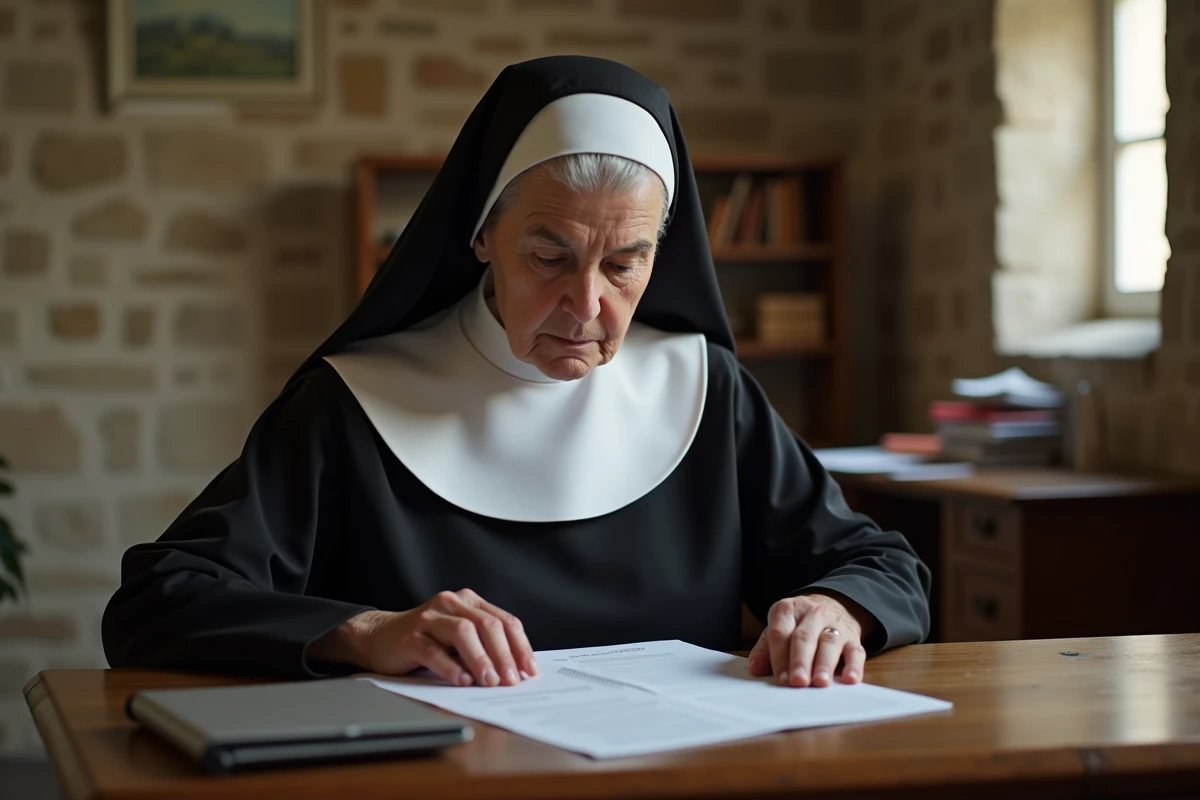
A figure drops, dry: zero euros. This is what a nun in France receives personally. No salary paid into an account, no payslip in her name. Life within a congregation is organized differently: housing, meals, health insurance, everything is covered. Any potential income from work or allowances goes into the communal pot. The individual dimension fades away, giving way to a collective organization that disrupts the usual benchmarks of the working world.
In some communities, it is donations, legacies, or the management of assets that ensure the majority of income. Even when professional engagement is intense, the rule does not change: no nun receives personal remuneration. The economy of the group takes precedence. This way of living runs counter to salary standards and requires a rethinking of the very notion of “earning a living.”
What a nun really earns in France: figures and daily realities
To understand what the salary of a nun in France really means, one must start with the vow of poverty. It allows for no individual remuneration: every euro earned, whether through teaching, caring, or administration, goes back to the religious community. The personal bank account disappears, as does ownership. One enters a system where everything is pooled.
The religious congregation covers all needs: accommodation, daily meals, medical care, clothing, travel. Social protection, retirement, and health insurance are provided through the CAVIMAC, the scheme for members of the clergy. Even when a nun has a regular job and receives a minimum wage, this salary is never for her alone. This rule applies everywhere, without exceptions.
Here are the various sources of resources that feed the collective budget:
- Income from work (teaching, care, crafts…)
- Sales of products made at the monastery or within the community
- Pensions and dedicated allowances
- Donations and legacies, often from former parishioners or relatives
The result: the daily life of a nun is organized without pocket money, or at most a small amount, granted for expenses approved by the superior. To grasp the exact functioning and meaning of these rules, a detour to the page “ the salary of a nun in France ” is essential. One discovers a radically different logic of life: value is not expressed in euros, but in the sharing and solidarity of the group.
Between spiritual commitment and material constraints: how is the financial life of nuns organized?
All financial decisions are made in community. Here, there are no individual accounts or payslips. The vow of poverty applies to every action: if one works, the salary goes to the congregation. Teaching, management, care, crafts: each activity nourishes the communal fund, never a personal wallet.
The religious congregation then covers all needs: food, housing, clothing, health. In-kind benefits replace salary. The CAVIMAC ensures medical coverage and retirement, under conditions specific to members of the clergy. Personal salary, on the other hand, remains a fiction: the notion has no concrete reality for a sister.
The collective budget relies on several pillars:
- Income from professional or craft engagement
- Pensions of the members
- Donations and offerings from parishioners
- Legacies or occasional assistance
Every purchase is subject to the approval of the superior or council. Individual choices fade behind the collective priority. This lifestyle combines spiritual commitment and the management of material necessities, far from the usual safety nets. Some nuns testify: personal expenses are very rare, and always justified before the community. Daily life is invented in simplicity, without excess or superfluity.

Church funding and support for communities: where do the resources come from?
The funding of the Catholic Church in France often remains opaque to the general public. In France, everything relies on the generosity of the faithful. The church tax, this annual collection in every parish, constitutes the main resource. Next come collections, occasional donations, legacies, and mass fees (set at 18 euros, with a ceiling defined by the Church). This model guarantees a relative autonomy but makes communities vulnerable to fluctuations in generosity.
The French state provides no direct support to the Catholic Church, except in Alsace-Moselle, where the concordat regime still applies. In these departments, priests and bishops are treated as civil servants: net remuneration varies from 1,200 to 2,200 euros for a priest, up to 5,000 euros for a bishop. Everywhere else, diocesan priests receive a monthly allowance of about 1,009 euros (2023), funded by donations, in addition to housing, health, and retirement through the CAVIMAC.
For women’s communities, the scheme is similar: work, pensions, occasional sales, and donations form the basis of the budget. No public funding supports the nuns, except for the Alsace-Moselle regime. The most modest congregations sometimes face real precariousness, depending year after year on the loyalty of donors and the dynamism of their initiatives. In the shadow of churches, economic fragility coexists with the strength of the collective. Who would have thought that a life devoted to others could depend so much on the generosity of strangers?